
Pasifika Maritime Future:
From Asia to Latin America-- a Neoliberal-Free, Independent Pasifika.

Toward a Maritime Future:
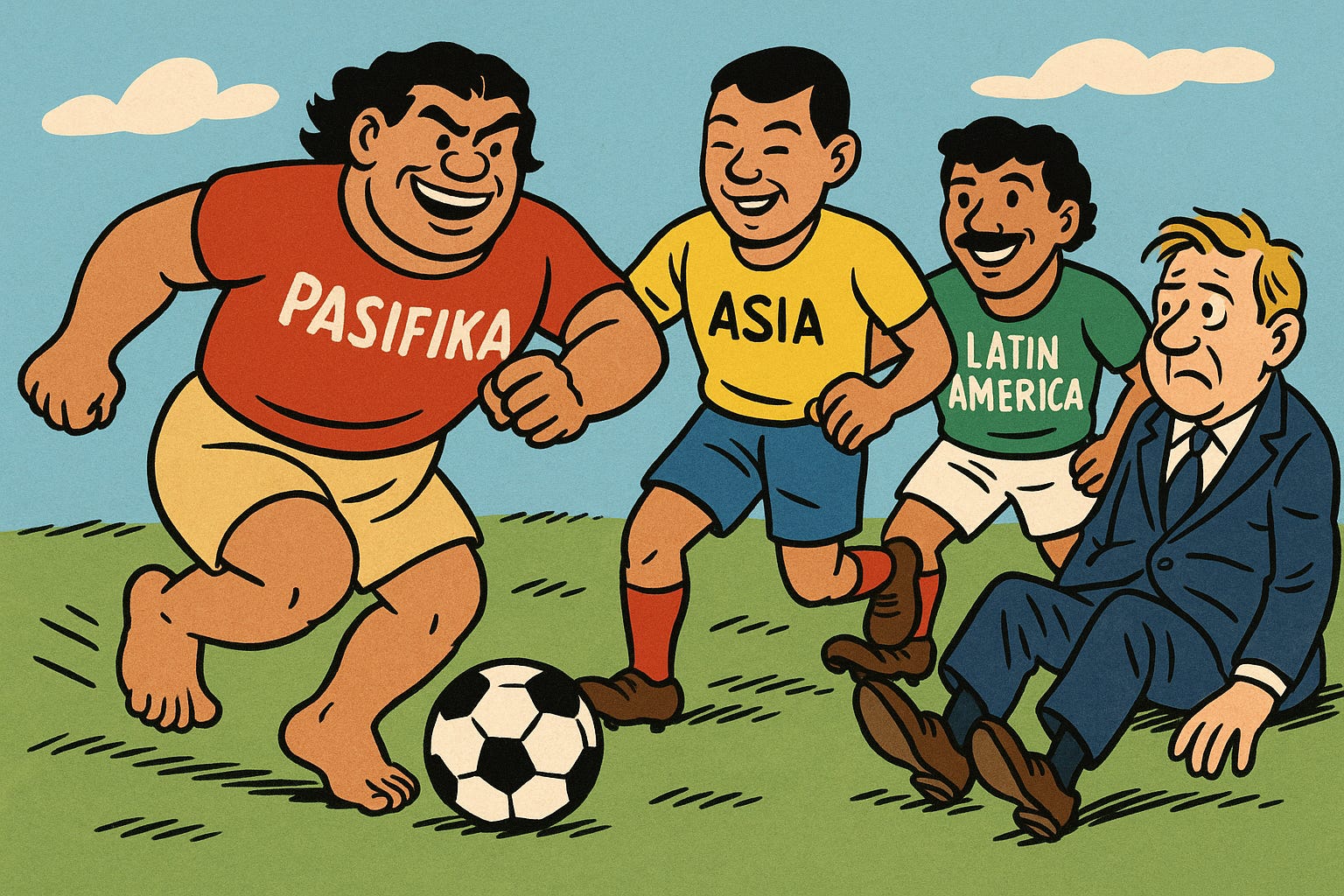
As Pacific Island delegates gather for the Third China–Pacific Island Countries Foreign Ministers' Meeting, the horizon feels open with possibility. Amidst persistent Western narratives warning against Chinese engagement, it is important to affirm that the Pacific is not a void to be filled by superpowers—Pasifika is an ocean of relation, a mat of kinship stretching from Asia to Latin America, a space that remembers what many modern states forget: reciprocity.
It is in this spirit that we welcome the potential of a China-led Maritime Belt and Road Initiative that looks beyond narrow geostrategic framing and begins to map trade and infrastructure along the equatorial currents. These currents— moving west to east and east to west, bending past the Galápagos towards Panama—carry more than cargo. They carry the promise of a renewed maritime commons, where Pacific Island Countries are not just stepping stones or choke points, but sovereign nodes in a new oceanic connectivity.
The possibility of enhancing east-west maritime trade between Asia and Latin America—through infrastructure aligned with Pacific currents and possibly even the long-discussed Nicaragua Canal—offers an alternative route to the Northern shipping passages dominated by U.S. naval and commercial interests. For PICs, this is not about choosing sides. It is about choosing futures.
Latin America, Asia, and the Pacific Islands share more than the Pacific. They share histories of colonial disruption, extractive economies, and diaspora. But they also share a vision—of sustainable, equitable trade rooted in local resilience, biodiversity, and cultural dignity. As trade corridors develop, let them be corridors of solidarity. Let Pacific and Latin American ports grow together—not in competition with nature, but in coordination with it.
This would mean balancing trade with ocean governance, building on regional frameworks. It would mean embedding indigenous leadership into port development, fishery agreements, and digital shipping infrastructures. Above all, it would mean centering the human currents—people-to-people exchanges, cooperative education, spiritual diplomacy—that make any infrastructure meaningful.
Promoting another kind of NFIP: A Neoliberal-Free, Independent Pasifika
In the spirit of regional gatherings past, we might recall the Nuclear Free and Independent Pacific meetings as a political, philosophical, and spiritual reference point. Then, the call was for sovereignty, demilitarization, and a Pacific defined by its own voice rather than by external forces. While NFIP was inclusive of the participation of peace and justice warriors from Latin America, Asia, Alaska, US First Nations, and Torres Strait, today we find ourselves navigating a different kind of encroachment—not nuclear testing, but economic saturation; not military bases alone, but market capture, conditional finance, and outsourced governance.
Perhaps what we are witnessing is the emergence of a Neoliberal-Free and Independent Pacific—where the language of free is repurposed to mean deregulated capital flows, and independence is brokered through multilateral development compacts. Where solidarity risks being replaced by infrastructure debt, asset management, and digital extractivism.
Yet it is precisely by remembering the clarity and vision of those earlier assemblies that we might reimagine the present—not to retreat into past formulations, but to reassert that independence cannot be defined by remaining enclosed by western criteria. The Pacific remains a site of relation, not transaction. And it is here, in this tension between memory and modernization, that new forms of alliance and resistance can still be charted— Local Data Sovereignty, for example.
In this moment of shifting currents, Pasifika might also draw strength from the emancipatory lineage of Latin America’s own insurgent imagination—from the defiant praxis of Che Guevara and Fidel Castro, who refused the hemispheric dictates of empire; from Subcomandante Marcos, who achieved Zapatista autonomy; from Paulo Freire, who taught us that liberation begins by naming the world in our own terms. We are reminded that revolution is not merely an event, but a process of collective becoming. Presidents Hugo Chávez, Evo Morales and Jose Mujica all reclaimed sovereignty as a hemispheric demand. These are not just icons. They are reminders that across oceans and mountains, movements have always prioritized dignity over domination, mutual care over managed scarcity.
So too must we remember Pasifika’s own lineage, which unmoors us from colonial enclosure and re-anchors us in ancestral continuity. Epeli Hau‘ofa reminded us that Oceania is a vast region of expansive connectivity. Haunani-Kay Trask refused the erasure of Kanaka Maoli nationhood, articulating a fierce and unapologetic vision of sovereignty grounded in land, language, and resistance to settler colonialism. Teresia Teaiwa revealed the gendered scars of militarization and the paradox of paradise. Our Pasifika teachers and schools—like the new Pasifika Communities University in Fiji, seeks to redefine what it means to decolonize from the inside out—politically, spiritually, and poetically. As we trace decolonial cartographies across accounting, education, and environmental justice, Pasifika voices call us not to replicate foreign models, but to deepen our ancestral consciousness, to listen to the ocean as archive, and to recognize that the struggle for self-determination in the Pacific is not new—it is ongoing.
Who better to support our economic realignment than a nation whose agrarian revolution broke the chains of feudalism, overcame a century of humiliation, and lifted hundreds of millions from poverty—not through submission to foreign capital, but through sovereign planning and collective mobilization. China’s experience under Mao, and its evolving post-revolutionary trajectory, offers not a template, but a lesson in resilience. Just as China endured decades of blockades and sanctions, Pasifika has weathered the long enclosure—first through colonial borders, now through neoliberal privatization and financialization. These regimes, couched in development rhetoric, siphon value from our ocean economies, fragment regional unity, and entrench debt dependency. The task before us is not simply to resist, but to reconfigure—to learn from those who reclaimed developmental sovereignty and to shape a future that is neither beholden nor peripheral, but intemerate and interdependent.
For too long, Western interests have held the Pacific apart—politically, logistically, and psychologically. The colonial map still lingers: territories administered from Paris, Washington, Canberra, and Wellington; trade and air routes designed to serve metropoles; regional institutions constrained by design. Infrastructure—what we lack, and what we are denied—has long served as a tool of control. Without regional cross-border agreements, undersea cables, or deep-water ports, our ocean is divided not by nature but by policy. Yet as new proposals emerge—linking Pasifika to each other and to Asia and Latin America along equatorial currents—we glimpse the formation of a liquid continent: not a bloc to be managed, but a constellation of sovereign relations. If developed on our terms, maritime and digital infrastructure will do more than facilitate trade—it will dissolve the conditionalities that have long defined our place in the world.
We have the opportunity now to resist being tethered to old Cold War scripts. Let this be the moment when Pacific Island Countries can link hemispheres not through conquest, but through genuine security.
