
Taking Virtuous Dramas by Strategy;
Popular ideological Instruction of Wēi Duǎn Jù

Moral Coherence under Siege
What began in Maoist China as a national project to reclaim art from elite institutions and return it to the people has, in the digital era, been reconstituted through the hyper-accelerated low-production format of the Wei Duan Ju, or mini-dramas. The revolutionary operas of the mid-twentieth century often involved village participation and ideological clarity and were attuned to the themes of collective struggle. Today’s mini-dramas continue this work on smaller screens, our mobile devices. In the US, subscriptions, depending on the platform, might be credit-based or cost about $20 a week, or $150 a year (subscription costs are much less expensive in other regions). You can also view some of them on YouTube for free, but often they’re dubbed, and sometimes, really poorly dubbed.
Where Mao’s operas dramatized class struggle within the party-state’s revolutionary horizon, Wei Duan Ju reframes that struggle through quasidramatic parables, using the tropes of capitalist antagonism to often mirror the ideological pressures China faces in the global system. Both forms, separated by decades, converge on a single task: to cultivate moral coherence under siege.
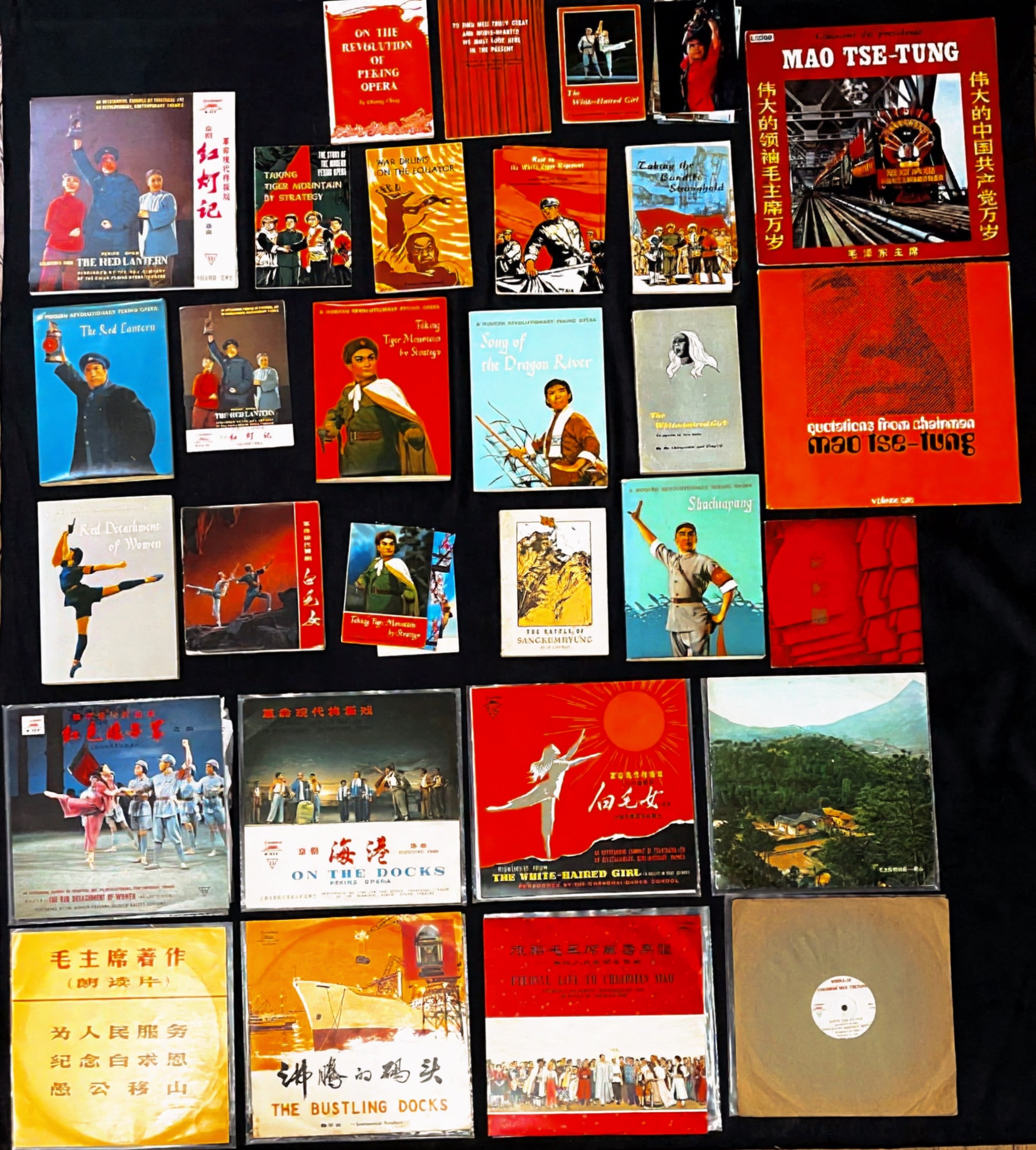
Under Mao, socialist realism dominated the stage and screen, dramatizing class struggle and party leadership through tightly controlled narratives. These model dramas were officially sanctioned revolutionary works—operas, ballets, and films—produced under the guidance of Mao’s wife, Jiang Qing, during the Cultural Revolution to embody socialist ideals and the revolutionary spirit.
On the other side of the world, the boundaries of revolutionary-themed artistic freedom were bursting out of the confines of theatrical convention with, for example, Julian Beck and Judith Molina of The Living Theater. As the PRC had put into practice the governance of revolutionary virtues, the West created art to express the virtue of liberation. In Mao’s 1943 “Talks at the Yan’an Conference on Literature and Art,” the goal was to bring art to the people, to communities, and to engage the nation with the responsibility of creating that art. In the West, that virtue was never achieved and remained in the capitalist paradigm of producers and consumers.
For Mao, model operas and revolutionary films served to shape the collective imaginary and moral horizon of the people, but how that is interpreted in China is very different from the West. There is an anecdote that I heard the Italian director, Michelangelo Antonioni, describe when I attended a retrospective of his films in New York’s Alice Tully Hall in the early 1990s. He said that Mao had agreed to let him shoot a film about China, a documentary called Chung Kuo, and he was the first Western director allowed in the PRC because he was well regarded as a revolutionary filmmaker. His film Zabriskie Point, which has been one of my favorite films ever, is possibly his least popular film. Still, it is a remarkably revolutionary artistic work, which may have given Antonioni the green light to make Chung Kuo. However, after Antonioni finished the film, Mao dismissed it as counter-revolutionary. It wasn’t until many years later that someone from China apparently apologized to Antonioni, saying that Mao didn’t understand Western montage. To claify, I don’t actually know how much of this story is true because I’m just relying on my retelling of this story over the years.
What Mao accomplished with, for example, the “White Haired Girl,” both a revolutionary opera and ballet with Chinese characteristics, was to mobilize production teams to carry the work from village to village, incorporating local interpretations of a well-known folk story. Through this process, a national opera was created not only for the people but with their participation, dissolving the elitist boundaries of opera and ballet to establish a new people’s theater. Michelangelo Antonioni, in his own context, pursued a parallel vision. In his early Italian films, including Zabriskie Point, he worked with non-actors and embraced revolutionary themes that ultimately drew scrutiny from the DOJ.
He lied like the West, but I loved him anyway…
Each mini-drama, while operating at the level of popular entertainment, is saturated with themes that easily prefigure China’s geopolitical condition. The antagonists in these stories do not exist in a vacuum. Ruthlessness, duplicity, excessive individualism, and manipulation are the familiar ideological figures of the West. These dramas do not name this figure directly, but they dramatize its logic. The villain misinforms, spreads rumors, disrupts, and obstructs. The villain conceals motives behind benevolent rights-based tropes of individuality, greed, fraud, and unregulated capitalist motifs. The antagonist often isolates the protagonist through deceit and destabilizes families, communities, and enterprises for personal gain. In this way, the villain’s behavior mirrors the accusations leveled by the PRC against the West: strategic containment, disinformation, subversion, and ideological warfare disguised as diplomacy.
Within this framework, Confucian, Taoist, and Buddhist principles are core ethical foundations integrated into Socialist values. Confucianism’s emphasis on harmony, loyalty, and obligation is often a guide to character development. In the face of fragmentation and deceit, the Confucian world asserts the importance of right conduct, social hierarchy, and reciprocal duty. The protagonist survives by reaffirming the bonds of trust and care. Taoism, with its grounding in contradiction and flux, often provides a mythological, if not interpretive, frame for enduring instability. The dramas spin into chaos only to return to balance. Buddhism introduces the inevitability of moral correction. The antagonist, however powerful, will fall. Not because someone takes revenge, but because the logic of his own behavior will undo him. These metaphysical traditions are positioned inside tightly constructed socialist value systems, even when there is an overt disparity between rich and poor. The morality portraying the arrogance of wealth is punished, while the access to wealth is open. And even within the contradictions of wealth, there remains an ethical narrative structure when the antagonists are hostile, unstable, and encircling. There is no end-of-times ending, no Judeo-Christian logic imposing nuclear war or genocide as a final solution.
This dynamic reflects the broader condition of the PRC’s place in global politics. China does not present itself as the global aggressor; it presents itself as the morally coherent actor surrounded by disinformation campaigns and strategies of containment. These dramas recode that narrative into domestic allegory. The viewer, watching the hero endure betrayal, humiliation, and marginalization, is invited to feel what the PRC claims to experience in the international system. And when justice is finally restored, when truth is revealed and the antagonist undone, the satisfaction is not just the predictable pathos of these low-budget dramas; they are more like a geopolitical imprint of a just and equitable future.
Socialism with Chinese characteristics relies on this integration of ideological messaging with civilizational continuity. It operationalizes tradition. Confucian harmony is not at odds with party discipline—it becomes its moral core. Taoist flexibility aligns with strategic patience. Buddhist karma becomes a justification for long-term vindication in the face of short-term loss.
The dramas are not propaganda in the crude sense. They do not require belief in policy or party doctrine. What they require is alignment with the affective truth: that the world is unstable, that justice is not immediate, and that faith in one’s own cultural and ethical system is the path to survival. This affective education—delivered through stories of betrayal, resilience, and harmony—is part of a larger soft power strategy. It does not speak to the West directly. It speaks to the domestic audience and to those abroad who find in these dramas a clarity absent in our own Hollywood system. Mostly, we would never admit that we have a soft spot for the ultra-low-budget Wei Duan Ju. They are about a virtual and moral endurance that, when properly cultivated, addresses personal salvation and national defense.